Learning is the only thing the mind never exhausts, never fears, and never regrets.
– Leonardo da Vinci
I will always remember the first conversation I had with my graduate thesis supervisor. I was at work one day when I happened to check my email – on my Blackberry, because it was 2013 – and saw the subject heading “Trent Anthropology MA”. Instantly my cheeks flushed, my hands turned ice cold, and my heart started pounding in my chest. I sat down and opened the email.
I quickly scanned for words like “accepted” or “congratulations!” before I noticed that the message wasn’t from university admissions. It was from Dr. Hugh Elton, a Professor of Ancient History and Classics who was about to become the Dean of Humanities at Trent University. The tone of the email was somehow both urgent and meandering; a habit, I would learn, that is not uncommon among academics. If I had 30 seconds to summarize the emotional rollercoaster that was his email, it would go something like this:
This email is about your application. (yes!) I am about to become very busy. (umm okay?) BUT, something in your application excited me. (awesome!) HOWEVER, I need to know more because I won’t be able to help you if what you’re interested in doesn’t fit within my exact area of expertise. (oh shit) SO, let’s sit down and negotiate over the phone. (ohmygod) BUT, we need to decide this very quickly. (ahhhhh). SO let’s talk today or tomorrow (*faints*).
He went on to briefly describe some areas of study he was exploring before signing off with what essentially boiled down to “if you go too far down the garden path, I can’t help you.”
I don’t handle nervous anticipation well on a good day, but what happened over the next week took everything to a new level. This, at the age of 22, was my future. From the moment I began my Undergraduate degree, my dream had been to attend graduate school. My area of interest always seemed to change, but I knew that when I grew up, I wanted to be a “Master”. In the years since defending my thesis (spoiler) and adding the letters “MA” to my email signature, I have thought about what propelled me further into academia and what, exactly, made my heart leap out of my chest when I saw that email.
If I am being honest with myself, I applied to graduate school for two reasons:
I love to learn. On every single strength, skill, personality, aptitude, and value test I have ever taken, something along the lines of “love of learning” always appears at the very top. I love learning, I love trying new things, I love experimenting, and I love diving deep down into the proverbial rabbit hole. I feel to my very core that I am a lifelong learner and I truly believe that learning and experiencing new things is a huge part of personal success and happiness. I also love the idea of learning. As I get older, I am beginning to understand the power that ideas like intelligence, knowledge, and expertise hold in my life and in how I see the world around me, for better or worse.
I have a pathological need to feel “smart”. When I was a kid, I remember receiving the same handful of “compliments” over and over. It’s possible that the adults in my life genuinely believed what they were saying. Or, it could be that there are only a handful of compliments that a non-parent adult can reasonably be expected to give to a child. For me, I was told that I was outgoing, pale, creative, pretty, skinny, and smart. While one of these things remains objectively true (hint: I am always wearing sunscreen), three of the so-called “compliments” on this list left me with a set of lifelong, mentally and emotionally damaging complexes.
It turns out that it’s not that difficult to be smart as a kid (as a childless former kid, take that for what it’s worth). Don’t eat the paste, look both ways, speak in full sentences, you know the drill. As you get older, however, the benchmark for “smart” becomes more broad and complicated. If you’re like me and heard “such a smart kid” enough times, you likely began to internalize the idea, which meant that the more there was out there to know, the harder you had to work to remain “smart”. Don’t get me wrong, it’s a wonderful thing to tell a child that they are intelligent, but what this did to me was set a permanent expectation that became harder and harder to maintain.
It was here, at the intersection of curiosity and insecurity, where I sat and read that email. Adding those letters to my name went beyond interest; if I were to remain “smart”, it was a necessity. I had to make this work. After reading the email for the sixth time, I somehow managed a halfway-intelligent reply and within a few hours, I would schedule the very first meeting with my future thesis supervisor.
Delightfully all over the place
That first conversation was one of the most stressful experiences of my life – even more stressful than actually defending my thesis. By the sounds of his email, I would have approximately 60 minutes to make the case that my proposed research fit so nicely into his work that I would need minimal supervision, allowing him to get on with his work of being the Dean. What it ended up being was less of an interrogation and more of a casual (at least on his end) exchange of ideas, culminating in the phrase that I will carry with me for the rest of my life. When he began talking about my research proposal and sharing some of the feedback from the admissions committee, he said “you have highlighted so many different interests here…you are delightfully all over the place”.
No word of a lie, “delightfully all over the place” is the only part of that phone call I remember with any clarity. That, and the “so and so will connect with you by email…” bit at the end. The only hard evidence I have of the entire week was his initial email (yes, I still have it), my reply, and the infamous research proposal that earned the complement of “delightfully all over the place”. Yes, I do believe it was a compliment. And better yet, I believe he meant it as a compliment. Now imagine it in an English accent and you’ll be right where I was.
Reading back over that proposal, it’s not hard to see where he was coming from. In a one page document, I proposed to study past human populations, the impacts of social and biological events on human remains, the archaeology of warfare and historical archaeology, palaeoecology, population dynamics, culture change, and postcolonial theory. Apparently, I wanted to do all of archaeology. Now that I think about it, “delightful” may have been generous. Whatever he intended, I have carried around that phrase ever since; as a sort of personal mantra to both encourage and celebrate my scatter-brained, erratic, rabbit-hole uncovering love of learning.
Get on with it!
So what is the point of this very long walk down memory lane and what on earth does it have to do with my happiness more than seven years later?
This week I tried something new and reacquainted myself with that curiosity and insecurity. To avoid the latter I could have completed a quick online course in a subject I was already familiar with or “taken the win”, as it were. Reading up on the connection between learning and happiness, however, I learned that many of us are actually doing the whole “lifelong learning” thing wrong. It turns out that most of us search for instant gratification and hop from topic to topic without ever spending real time with challenging concepts. We do training courses and collect certificates to “prove” we’ve learned something but we tend to forget almost everything within a month. To reap the rewards, we need to engage in learning that is difficult but doable. The kind of experience you become so absorbed in that time seems to stand still.
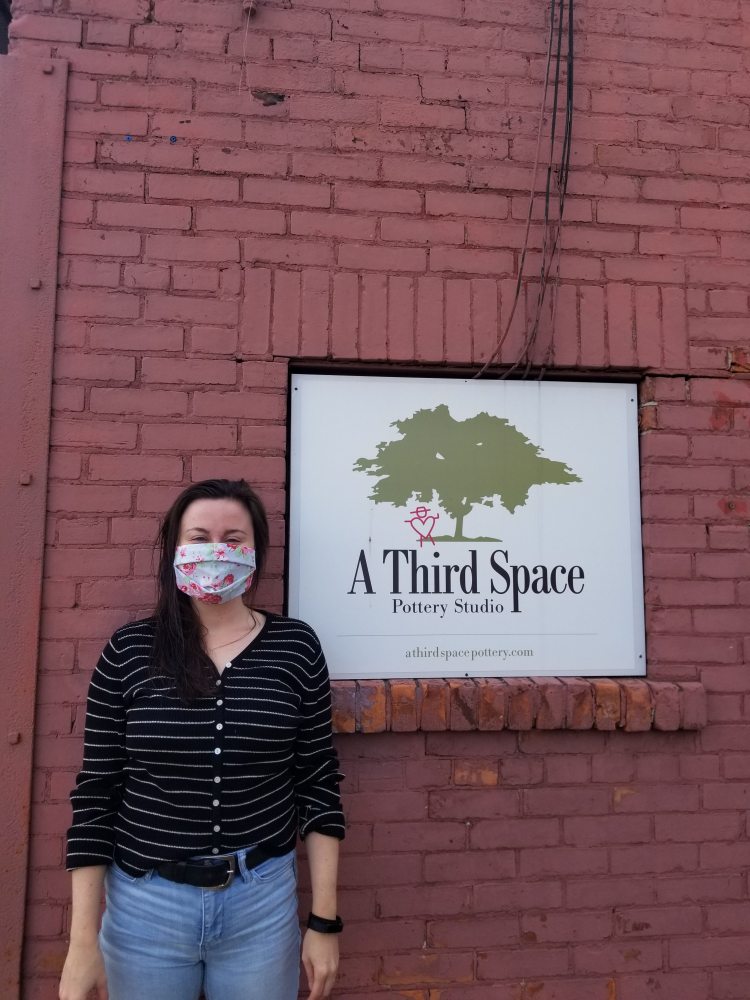
Wracking my brain for a worthy activity, I looked in my calendar and remembered that my wonderful husband had signed us up for a pottery workshop right at the end of the week. I could not believe how perfect it was. I knew absolutely nothing about pottery other than the movie Ghost (which I have never actually seen), the likely presence of a “wheel”, and the various bits of pottery we own that were made by other people. It would be something completely new, physically and mentally challenging, and an experience during which I would likely lose all track of time. That, and I had always wanted to try a pottery class.
I felt a lot of different emotions leading up to the day of our class. I was excited to try something new, eager to do something with my hands again, and confident that this experience would bring happiness. I also inadvertently dusted off the cobwebs from some of my childhood insecurities. I went to an arts school as a kid so I was supposed to be “creative” and “good at art” (whatever that means). My husband always says “you’re so much better at this than I am” when I’m making Christmas gifts, doing any sort of craft, or even planning a dinner menu. But what if he was better at pottery than I was?
I like trying new things, but did I forget to mention that I am terrified of doing them poorly in front of people? There is a reason that I prefer running and yoga over team sports. It’s the same reason that I hate playing board games I’ve never played before, why I never shared my grades, or why I haven’t done karaoke in more than a decade. Just like my need to feel smart, I have a deep set need to appear competent, capable, and “impressive”. I have decided what kind of person I want the world to see – someone that is smart and good at things – so I work really hard to control the narrative and as many variables as I can manage. If I don’t try it, I can’t fail. If no one sees me fail, then the idea of me being good at it can keep on living. But you know what I’ve discovered over the last few years? By not trying new things, I’ve already failed.
We arrived at the workshop on Saturday morning with our masks on, our curiosity piqued, and our clothes ready to get absolutely filthy. All eight of us sat at our wheels, lined up along the wall, and looked over our shoulder at the teacher’s demonstration. She slapped a ball of clay on her wheel and went through each of the steps we would need to take, from centering our ball, to where to put our hands, how to make different shapes, and the importance of keeping everything nice and wet. Then she said “have at it!” and we all grabbed our clay, awkwardly plopped it onto the middle of our wheels, and tentatively pushed the pedal.
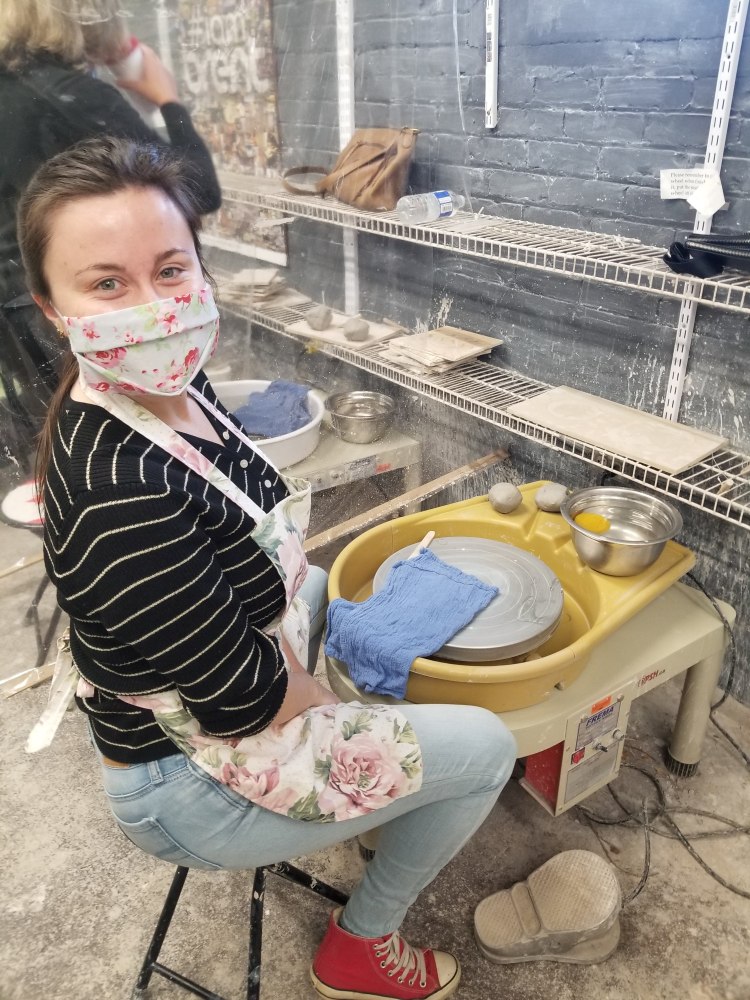
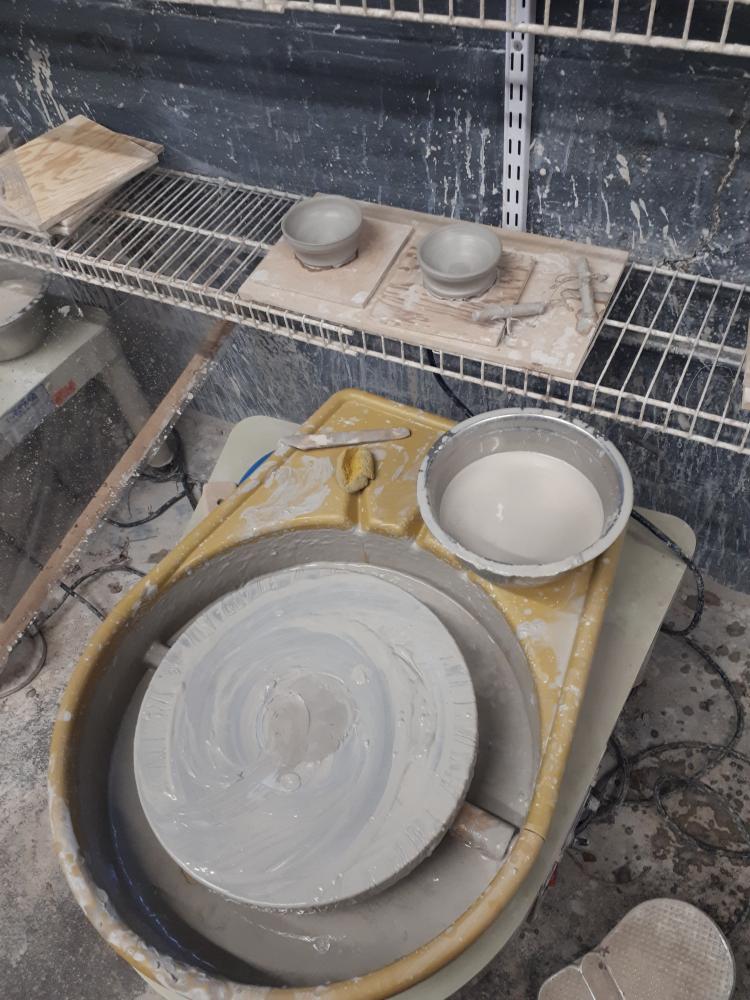
If you want a perfect example of two different approaches to learning, look no further than my husband and I. I carefully centered my clay, positioned my hands, and slowly started to spin my wheel. I shaped my clay slowly and deliberately, constantly checking over my shoulder to see what everyone else was doing. At each new step of the process, I called the teacher over to make sure I was doing it right. The moment I had a decently shaped dish, I quit while I was ahead. My husband, on the other hand, dove right into his project and instead of constantly checking, he experimented, tried new things, and explored the slippery medium on his own terms. While I stuck with the basics, he tried more advanced techniques. While I was focusing out the outcome, he was elbow deep in the experience. He laughed, he joked, and he had a wonderful time. For the first half of the class – until I had finished the two projects I would take home – every muscle in my body was tense and my eyes were hyper focused. Tyler was there to learn something new. I was there to learn something and prove it.
Proof. No explanation necessary, right? This is one of the more upsetting reasons why I so urgently pursued graduate school. I thought that if I walked into a room with an M.A., my expensive credential would tell everyone all they need to know. This girl is smart, capable, and worthy of a seat at the table. I wanted proof that I was smart so I didn’t have to spend the rest of my life convincing everyone – and myself – that I could do it.
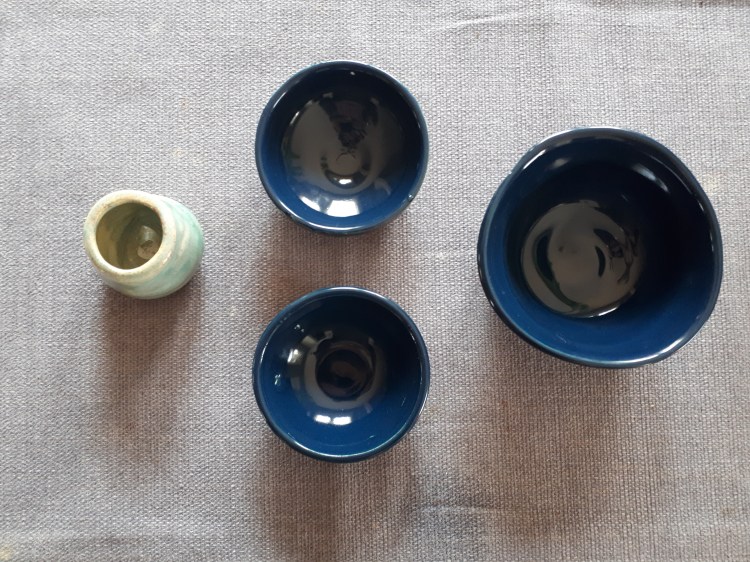
That’s why I made two small, shallow, matching, and arguably useless dishes. They looked good. They looked like proof that I was creative, talented, and good at pottery. They looked good because they were probably the easiest thing that ten fingers and half a brain could make on a pottery wheel. Yes, I stepped outside my comfort zone by trying the class and learning something new, but only just barely. My Master’s degree is proof of many things – of my time spent learning, of my enrollment at Trent University – but intelligence is not necessarily one of them. For years I believed that a piece of paper would give me confidence and all the proof I needed that I would forever be “qualified”. I made certain assumptions about people with less, similar, or more education that I have. The reality is that each piece of paper is only worth the experiences you have, the knowledge and skills that you acquire, and most importantly, what you put into it. I’m slowly learning how to shape that MA into something useful and meaningful to me, and not as proof of my intelligence or ability. Because no matter what it looks like or what other people think of it, I truly cherish it. Just like my little, useless dishes.
Lucky for me this story has a happier ending.
I finished my little projects with time to spare. I looked over at Tyler, laughing and covered in clay, and I grabbed another ball. I took a deep breath and slammed my ball of clay into the centre of my wheel. I got my hands into position and I hit the pedal. I watched my hands support each other as they gently shaped the gray lump in front of me. I felt the sleek wetness spin through my fingers as the lump transformed through the rhythm of the wheel and the gentle pressure of my body. I pushed and I pulled, lifted and shaped. The pressure of creating something was gone; replaced with the joy of simply creating. I had no idea what I was doing and I didn’t care. I smiled as I manipulated the clay. I laughed when the wheel got out of hand and my “cup” went wobbly. I poked my fingers into different parts of my little aberration just to see what would happen. I experimented with pressure, speed, motion, and stillness. I let my curiosity run wild and I was happy.
This week I accepted a challenge, learned something difficult but doable, and completely lost track of time. I left the pottery class with a smile on my face. I got to honour both versions of myself; the one who controlled the narrative with two well-crafted but simple dishes, and the other who learned, created, and experienced with joyful and reckless abandon. Stepping even slightly out of my comfort zone this week was thrilling, anxiety-provoking, and wonderfully fun. Exploring my need for performative ability was an unexpected challenge but one that I know I need to accept and overcome so I can keep learning how to be happy.
Sources
9 Things You Can Do to Be Happy in the Next 30 Minutes
Gretchen Rubin | @gretchenrubin | ( https://quiz.gretchenrubin.com/ ) on Real Simple
Why Learning Makes You More Happy, Healthy and Wealthy
Shivani Gopal | Medium
 How to Be Happy