To be a member of a vulnerable community is to get no mental vacation from injustice, have no physical shield from the tumult, find no easy emotional escapism from the terrors of the day—and to intentionally avoid their non-optional nightmares is an abdication of our responsibility as people living in larger community with them
– John Pavlovitz
At one point in time I operated on the assumption that tuning out the news could make me a happier person. I assumed that by avoiding current events I was protecting myself from tragedy, anguish, and suffering that had nothing to do with me. At one point in time I assumed that avoiding the news – and reality – was all part of the noble pursuit of happiness.
Thankfully this version of me finally died in March 2020, but I get the impression there are many out there still who truly believe that ignorance is bliss. If you, dear reader, believe that you bear absolutely no responsibility for what goes on in the world around you then you may want to skip this one. I will get right to the point: there is taking a break from the news to mentally recharge and there is choosing to remain ignorant of anything outside your own experience. One of these approaches is a productive form of self care. My issue lies with the other.
News News is Good News
In preparation for a week without news, I searched the internet for a connection between consuming the news and personal happiness. Almost every single article I came across was some version of “avoiding the news makes you smarter” or “here are several reasons to quit the news”.
According to the wisdom of the internet, the following is true:
- The news is depressing and you will feel better when you stop paying attention to it
- Most conversations about current events are people “talking out of their asses” and the news is, therefore, not the best way to stay informed
- “Being concerned” about the news is mostly performative and makes us feel like we’re doing something when we’re actually not
- Everything being reported in the news is beyond your circle of influence (which is apparently different from your “circle of concern”)
- The news will simultaneously make you both desensitized and hyper-sensitive
- The news is effectively brainwashing us, distorts reality, and only shows “exceptions to the rule”
- The news is “empty calories” for the mind
- You don’t need to bother staying informed because you’ll never “catch up” anyway
- Consuming news is time consuming
To be fair, there is some nuance here that I can get on board with. The news can be “depressing” and often distorted by bias; expressing concern without action – especially on social media – is largely performative; and yes, unless you work in the news, you probably won’t “finish” it before the next news cycle. But, as I was reading all of this, some questions kept nagging at me:
- Before I consciously uncouple from it, what exactly is the news?
- What is my relationship with the news? What is that relationship like for other people?
- What does it mean for me to turn off the news?
- What does it mean to have the privilege to turn off the news?
- What am I responsible for knowing? Reading? Doing?
Then, when the word “privilege” popped into my head, I immediately realized that I had been looking for the wrong thing so I typed “the privilege of ignoring the news” into the search bar. Now I was reading titles like “The White Privilege of Ignoring the News”, “Respond to Negative News, Don’t Ignore It”, and “The Privilege to Ignore Racism”. I realized what had been bothering me: my relationship with the news, as a White middle-class woman, has always been optional.
This week I disconnected from the news and these are some of my thoughts:
Laura is “in a relationship” with The News (and it’s complicated)
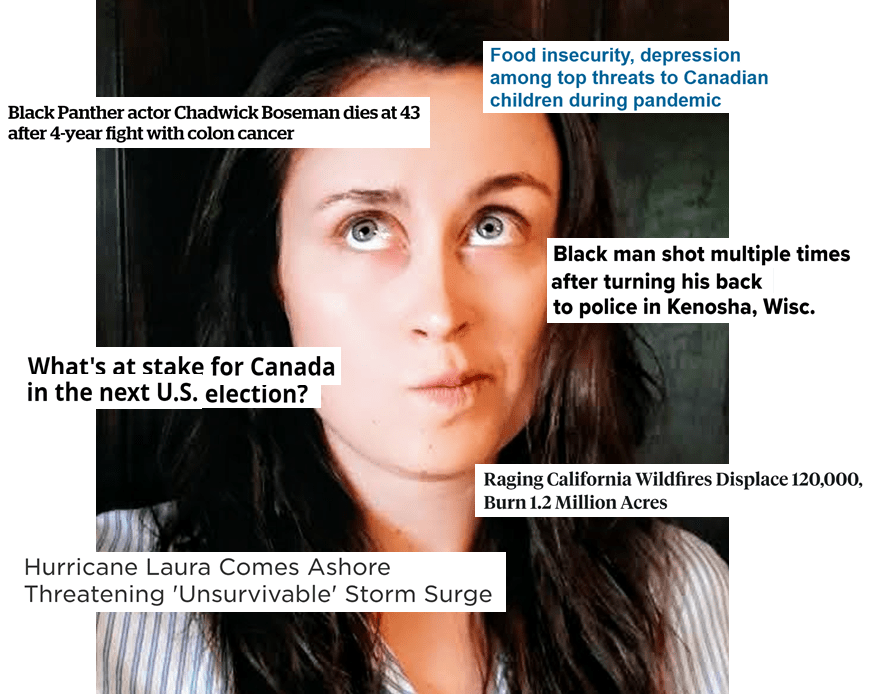
I consciously interact with the news a minimum of seven times every day. After I shut off my alarm in the morning I check the notifications on my phone, usually the news compiled overnight by Twitter and the local, national, and international news from a downloaded news app (1). When I turn on my computer I check both my personal and work emails and read a daily current events newsletter (2) and news from a Listserv about my industry (3). At lunch, I check my phone again and read the mid-day updates from Twitter and the news app and listen to a current events podcast (4). I will check the major outlets at least once more in the afternoon (5) and once around dinner time (6). Finally, every night my husband and I listen to the evening news and, more often than not, fall asleep to it.
It seems like a lot. And that’s just the intentional news consumption which doesn’t include listening in the car, talking with colleagues, friends, and family, and mindless scrolling through social media. Whether I like it or not, I spend a lot of my day with the news: reading, listening, scrolling, clicking, sharing, talking, and thinking. Breaking this down got me wondering what kind of an impact this constant flow of information – negative or positive – is having on my brain. What exactly am I consuming on a daily basis? How does it make me feel? How does each piece of information influence my thoughts, beliefs, and actions? What would happen if I just unplugged?
In my internet search I came across several studies about our species’ thirst for information and the psychological impact of information overload. According to neuroscientist Marianna Pogosyan, humans seek information because of what we predict the information will do to us, regardless of what it actually does. It all boils down to three motives: utility (can this information help me?), cognition (can I use this information to better understand the world?), and emotion (can the information make me feel good?). But is knowing better than not knowing? After all, the news could give me bad information that is not useful and has a detrimental effect on my actions and emotions. So what should I do?
Privilege and Ignorance
While the science of news consumption may sound clear cut and comforting, there are several reasons to look at the social determinants of our relationship with the news. Every person experiences these motivations in different ways, depending on their experience and circumstance, with different mental health outcomes. And that is where it gets messy and decidedly less comfortable.
Consider this: when I (a White woman) read the news in 2020, I likely see – and experience – something very different from someone else (a Black man, perhaps) when looking at the same thing. When I (a White woman) read that Jacob Blake (a Black man) was shot seven times in the back by police, I saw a man who was targeted for the colour of his skin, which is different from the colour of mine. I felt shock, sadness, and outrage, but when I finished reading I still got to feel safe. When I put down my phone I still got to feel safe. When I left my house, walked down the street, talked to a stranger, walked by a police cruiser, I still got to feel safe. I know that if it all becomes too much, I can turn it off, tune it out, and protect myself because I know I will not be called upon, as a White person, to answer for the actions of another White person. Unlike the Black man reading the news, I will not be called on by every White person I know to defend the actions of a complete stranger, define lethal force, police brutality, and systemic racism, or to remind people that even if someone has been pulled over, is acting “suspicious”, has a criminal record, or has been mistaken for someone else, they do not deserve to be unlawfully killed by the police.
Unlike many others, my relationship with the news is completely on my terms; I can choose when to engage and about what. This is the phenomenon that John Pavlovitz writes about in his article “The White Privilege of Ignoring the News”:
“If there is evidence of privilege, that’s it: to feel so insulated from adversity, so inoculated from suffering, so immune from struggle, so unaffected by reality—that you could simply turn off the news, because the act feels inconsequential to your existence. It reveals that not only do you feel the events of the day have no tangible or lasting effect on you, but you’re blissfully ignorant to the way those events are painful, invasive, and even deadly to less fortunate people who lack the luxury of being oblivious; that soft, warm, intoxicating place you’ve chosen to nestle down into while the world is burning.”
I enjoy a privilege not experienced by everyone: I can take a break, or go on a “mental vacation”, from the news. Not only can I take a break from information overload, but I can choose to take a break from injustice, and I can return when I am ready, on my own terms. I can decide that I want to be happy and I can choose to wake up from the “non-optional nightmares” of others. This week I sat and learned from the discomfort of this privilege.
Happiness and my Week Without News
I set out to stop reading the news for a week but I don’t exist in a vacuum. When I opened my phone I still saw the headlines, although I chose not to open them. I exist in a world where people talk about current events and I didn’t walk out of the room. When my husband turned on the evening news I put in my headphones and tried to tune out, but afterward he still told me what I needed to know. This week I didn’t miss the constant updates about the completely asinine thing POTUS Tweeted this time, but I did miss the ritual of engaging with the world. I missed the evenings with my husband listening to the news and unpacking it together. I missed engaging with my friends and colleagues about everything from anti-racism protests to what Harry and Meghan are up to these days. The news is humanity and I missed feeling like part of humanity.
Cards on the table, this wasn’t the first time this year that I have pulled away from current events. In April or May, when the news of COVID-19 was at its height and everything seemed hopeless, I will admit that I took a bit of a break. There was an outbreak in my Nana’s assisted living facility, no one’s jobs were secure, and the case numbers kept climbing. Every time the news came on I felt a wave of anxiety. I isolated the cause of my distress, identified what I needed, and reduced my exposure to pandemic-related updates for a few days. That physically and mentally made me happy and since then, I have had no issues.
Did distancing myself from the news this week make me happy? Honestly, I think it had the opposite effect. Every day I felt like I was missing out on something important (not quite withdrawal, but something like it?) but I also felt angry; angry with myself and my ability to disconnect without consequence and angry with people out there – people like me with privilege – who make the choice every day to remain disconnected.
This week I chose to live without the news as a short-term personal experiment. I always knew that I would revert back to my regularly scheduled programming after seven days but, when I planned this week back in January, I figured that by now I could probably use a break from coverage of the U.S. Election. I didn’t anticipate a global pandemic, the murder of George Floyd sparking a social and cultural revolution, and an actual hurricane called Laura making landfall (I can’t make this up!).
The version of me from the beginning of this story – the one that believed that my emotional detachment from the news was completely without consequence – would likely have enjoyed a week free from upsetting information. This version of me may have “caught up” the next week, or have simply been blissful in ignorance. This version of me existed in the time before the pandemic and the Black Lives Matter movement. If I’m being honest, she probably still exists somewhere.
Present-day Laura, however, struggles with balancing the call to civic responsibility and allyship with the messaging about mental health and personal well-being. I know that I should always put on my own oxygen mask before helping others (or fill my cup before filling others, or take care of myself…you get the picture), but I also know that I am never going to be “ready” to hear about tragedy and I am never going to be “centred emotionally” enough to watch the rising death toll of people of colour at the hands of the police. I could wait, but I know that time will not come. I may struggle with the news at times, but I have it easy. I know that this struggle – so minor in the face of others – will not overtake me, it will not put me in danger, and it will not destroy my chance of Happiness. My “struggle” with the news is a choice, in a sense, but I see it as an imperative. My privilege lets me choose whether to detach or engage, but I know I will never be happy (or Happy) to stick my head in the sand, ignore an issue and hope it goes away, or live in “blissful” ignorance when others are in a nightmare they can’t wake up from.
My answer to the question of “how to be happy” this week will likely be different from yours – whoever you are – but I challenge you to think not only about what makes you happy, but what privileges allow you to be happy or shield you from unhappiness. It may be uncomfortable, but I promise it will be worth it.
Sources
15 Simple Things to Do to Be Happier Today
Quincy Seale, Keepinspiring.me
45 Things You Can Do to Get Happy No Matter Where You Are
Courtney Johnston | @CourtRJ | ( http://www.rulebreakersclub.com/) on Lifehack.org
7 Reasons Why You Should Stop Watching the News
Niall Doherty | eBiz Facts
Five Things You Notice When You Quit the News
Raptitude.com
The White Privilege of Ignoring the News
John Pavlovitz
Why Avoiding the News Makes You Smarter
Martijn Schirp | Highexistence
Why We Can’t Stop Watching the News
Marianna Pogosyan | Psychology Today
 How to Be Happy