If you want to be happy, set a goal that commands your thoughts, liberates your energy and inspires your hopes.
— Andrew Carnegie
New Year’s resolutions have existed since at least the early 19th century, possibly dating as far back as the late 1600’s. Ever since then, people have been making and breaking resolutions every January in a relentless cycle of hope, expectation, failure, and disappointment. Out of curiosity, I asked the internet for the most common New Year’s resolutions and I discovered, unsurprisingly, that “exercise more” appeared as either number one or number two on every single list. (If you’re wondering, others in the top three were some combination of spend less, lose weight, and sleep more.)
While perusing the lists of common resolutions, I noticed that they were all qualified with either the word “more” (as in sleep) or “less” (as in spend). All of these resolutions seemed just vague enough that they might be attainable – after all, if you manage an extra five minutes every so often, I suppose you’re technically getting “more sleep” (success!). At first, it would seem that this lack of specificity would make sticking to a resolution easier; a looser definition of success, so more room to fail. Yet, every single think piece, business blog, and academic study I found said the same thing: you are more likely to succeed if you make your goals Specific, Measurable, Achievable, Relevant, and Timely (S.M.A.R.T. – how clever).

Every December, like clockwork, I get very motivated by the “new year, new you” mentality and start to essentially list everything I don’t like about myself in reverse, telling myself that these things are goals or “resolutions”. For example, “I can never keep my home office clean, I am clearly a slob” turns into “I resolve to be more organized this year”. “I am so incredibly lazy why am I not at the gym seven days a week” turns into “Exercise more”. Letting myself off the hook for the negative self-talk every December by putting a positive spin on my unrealistic aspirations is a predictable set up for disappointment every February.
Predictably, like everyone else on the internet, one of my annual resolutions is to exercise more (whatever that means). So back to Week Three: Set a Fitness Goal. “Exercise more” means something different to everyone. For someone who runs three times a week (been there), it may mean increasing to four times. For someone who doesn’t own a pair of running shoes (also here), that’s an entirely different story. What would happen if these two imaginary people swapped fitness goals? Nothing very productive.
That is why this week, I aimed to set an actual goal and not just rely on my yearly aspiration to exercise more. I wanted to do it right: set a goal, make a plan, and plan for failure and forgiveness. As I sat down to begin this week, something dawned on me: I don’t know if the “happiness” comes from an increased level of fitness, the act of creating a goal, the satisfaction of achieving a goal, or some magical combination of the three. More than likely the latter is true, but the only way I can find out for sure is to successfully go from planning to achieving. So how can I create a fitness goal that I have a decent chance of completing?
Sure enough, the web is full of people breaking down exactly how to set a fitness goal and how to stick to it. After combing through dozens of them, I chose a piece in Self by Jenny McCoy. She takes the S.M.A.R.T. framework and expands it to factor in some very human tendencies, like being over-ambitious, discouraged by failure, lacking in self-awareness, and not understanding the motivation behind our goals. I walked through all eleven steps in her article and came out the other end with my goal: run two 5k races before my birthday in October.
Here are some of my thoughts on the process (for her full list of steps, read the original article):
Step 1: Focus on one goal at a time.
People (like me) have a tendency to set a whole mess of goals and get very discouraged when they’re not able to simultaneously hit the gym every day, cut out added sugar, and get at least 8 hours of sleep every night. So, I narrowed my focus: I would like to start running again. I like running, it’s doable, I’ve run before.
Step 2: Make it your own

A lot of fitness goals are inspired by social media and, let’s be honest, what you see out there is usually the very best version of some very fit (and professionally lit) people. Basing your goals off of people who work out for a living is not productive or practical. So, I based my running goal on my own experience. In the fall of 2018, my sister asked if I wanted to run a 10k race with her the following spring. Neither of us had much experience with long-distance running, but we decided to train together (from afar, as she lived 6 hours away). We made a plan, found an app, and eventually ran (and finished) the race. The combination of motivation and momentum was perfect: I was going to keep training, eventually making my way through a half-marathon. However, in my final days of training for our 10k I sprained my ankle and, out of sheer stupid determination, I decided to run the race anyway. I don’t regret my decision, but it definitely set my post-race training (and momentum) back by several months.
Step 3: Make it measurable, specific, and time-bound
Following the S.M.A.R.T. framework will force me to be realistic and actually allow me to track my progress.
Specific: two races, 5k each
Measurable: again, two races, 5k each
Achievable: I have run a 10k before, so I think I can manage this
Relevant: this fits with my broader goal of increasing my level of fitness, and running is something I enjoy doing
Timely: giving myself 10 months is specific, realistic, and reasonable
Step 6: Understand what’s driving your goal
Sometimes goals are driven by underlying fears, insecurities, and negativity. Depending on what you’re trying to accomplish, it can stir up a lot of emotions. What drives my goal? Running makes me feel good, training for a race reminds me of working together with my sister, and completing a race gives me a sense of accomplishment (and a medal!).
Step 8: Develop micro-goals on the way to your big goal
Including smaller, confidence-building goals that can be achieved in a shorter time-frame will help build a sense of accomplishment. I broke my 5k goal down into months, adding elements like number of weekly runs, hitting my daily 10k step goal, and pushing myself further.
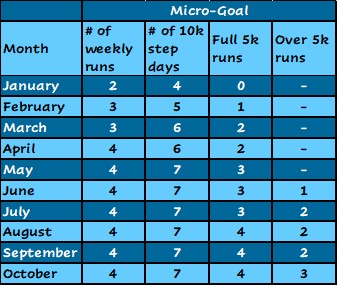
Step 10: Be honest about your prior and current habits
To get where you’re going, you have to know where you are. What can I (or will I) do to alter my existing habits? I have learned from experience, for example, that I am much more likely to run in the evenings. If I only budget running time for 6am, I am probably not going to be successful.
What’s next?
Finding the “happy” this week was easier than I thought. After all, I know my pattern: write a very long list of resolutions, get excited and tell myself that “this is the year!”, realise that there isn’t enough time in the day to succeed without becoming an entirely different person (and probably quitting my job), and then get discouraged and put off real goal-setting until the next big milestone. It. Never. Works. When I became intentional and realistic about my goal, the process of creating a plan was exciting. Figuring out what I wanted and why I wanted it made being honest with myself a lot easier. I could acknowledge the hurdles, identify my weaknesses, anticipate my excuses, identify reasonable sacrifices, and find ways to take action every day. I managed to hit all of my targets (or micro-goals) this week, so I have hope for the next ten months. I don’t know what October will look like, but I have left myself a lot of room for success, failure, and forgiveness.

Sources
How to Set Realistic Fitness Goals You’ll Actually Achieve, According to Top Trainers Jenny McCoy, Self.com
How to Set SMART Goals (image credit) on BBPsales.com
 How to Be Happy
Great post
LikeLike